

Job indicators are good guides to an economy’s underlying health. More people working means extra spending, extra growth – and likely higher share prices too. But if dole queues lengthen, an economy, and many firms within it, will suffer.
US ‘initial jobless claims’ (IJC) show how many Americans are claiming state unemployment benefits for the first time. And the four-week moving average of IJCs, which filters out the weekly ‘noise’, has generally been a handy pointer to future changes in both the US economy and the stock market.
For the week to 10 September, IJCs climbed by 11,000 to 428,000, worse than expected by economists. And the four-week moving average climbed by 4,000 to 419,500. That’s the highest level since mid-July.
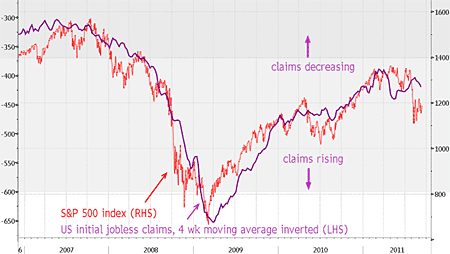
What does this mean for stocks? Look at the chart.
Source: Bloomberg
The purple line is the inverted IJC four-week moving average. The higher this goes on the chart, the fewer claims are being submitted. So a rising purple line is good news, and a falling line bad news. The red line is the S&P 500 index, the world’s most watched stock market index.
The IJC figures forecast its May drop, and also its June rally, very neatly. Of course, the S&P 500 has since taken a real tumble, of which the IJC figures didn’t forewarn. But now the latest turndown in the IJC four-week moving average suggests that the recent rally in the S&P index may well not last much longer.
Category: Economics