

Jobs are crucial to economic expansion. If more people are in work, that means extra spending and higher growth. But if dole queues get longer, economies suffer. No wonder that job creation in the world’s biggest economy, the US, is one of the most widely-watched indicators on the planet.
Our favourite US jobs measure – updated every week – is the ‘initial jobless claims’ (IJC) number. It shows how many Americans are claiming state unemployment benefits for the first time.
In particular the four-week moving average of IJCs, which filters out the weekly ‘noise’, has been a great pointer to future changes in the US economy. What’s more, it’s just as good for the stock market too.
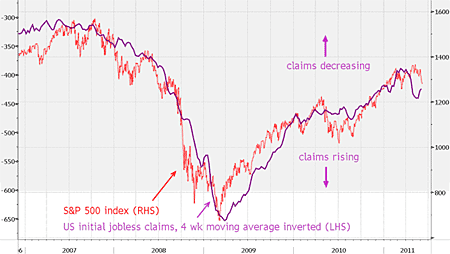
The latest figures are just out. For the week to 4 June, IJCs rose slightly to 426,000. That was worse than expected – economists expected a drop to 419,000. Meanwhile, the four-week moving average dipped to 424,000. That’s the lowest since 22 April – but average IJCs are still 7% higher than three months ago. Look at the chart:
Source: Bloomberg
The purple line is the inverted IJC four-week moving average. The higher this moves on the chart, the fewer claims are being submitted. So a rising purple line is good news, and a falling line bad news.
The red line is the S&P 500 index, the world’s most watched stock market index. The IJC figures forecast its latest fall to a tee. And although the IJC four-week moving average has improved a bit, it’s still pointing to more pain ahead for US stocks.
Category: Economics